
Let’s geek out with a little bit of history! We found the following article by Tanner Bates so fascinating that we thought we had to share it with you. We know you love an educational read.
Oak bark leather
Who are Tanner Bates?. Those of you who are avid followers of Herring Shoes may recognise their name. They are the local leather company we use to make some of our accessories and belts using oak bark leather. This special leather is made using an ancient, fascinating technique to creates a thick, hardwearing product. Any item made using this leather will exhibit superior longevity in comparison to most other leathers.
You often find our higher end shoes made with oak bark leather soles. If you wish to see all products on our website exclusively made for us by their artisans, please see here for men’s and here for ladies.

The history of leather
So, the history of leather. A timeless material, it has been an essential part of human history for thousands of years. This article aims to explore the fascinating origins and development of this leather. We consider the craftsmanship involved in transforming this raw material into beautiful and functional objects. We’ll take you on a journey through time, highlighting the various milestones in the evolution of leather and its ever-present role in human society.
The beginnings of leather: Pre-history to ancient civilisations
Leather can be traced back 400,000 years ago in Hoxne, England. From the Stone Age to the Iron Age, ancient civilisations began to harness the potential of leather for various purposes. They utilised animal skins for protection, clothing, footwear, and tools, marking the beginnings of leather craftsmanship.
Leather in the Stone Age (pre-history to 3000 BC)
During the Stone Age, early humans began using stone tools to skin animal hides and scrape them clean. This would prepare them for the tanning and preservation processes. These early leather works provided clothing, shelter, and footwear for our ancestors.
Leather in the Bronze Age (3000 BC – 1200 BC)
The Bronze Age saw significant advancements in leather production and craftsmanship. With the development of trade, tanning techniques improved. Shoes, capes, belts and protective gear were made from leather. Leathercraft reached new heights during this period, with artisans creating intricate designs and finishes on leather products.
Leather in the Iron Age (1200 BC – 550 BC)
The Iron Age witnessed further advancements in leather production and craftsmanship. Leather became an essential material for a wide range of applications, from clothing and shoes to military gear and equipment. The Roman Empire made extensive use of leather, revolutionising the leather industry and setting the stage for its continued growth.
The evolution of Leather in Ancient Greece and Rome
Leather played a significant role in the lives of ancient Greeks and Romans. From 800 BC onwards, these civilisations used leather for various purposes, including footwear, clothing, protective gear, and even storage containers. Other applications included the production of shields and bags, demonstrating the versatility of this remarkable material.
Leather in Ancient Rome (800 BC – 476 AD)
The Roman Empire was a major consumer of leather: clothing, shoes, belts, harnesses, boots, saddles and tents. The Romans developed innovative tanning techniques to produce softer, more versatile leather that could be used for a wider range of applications.
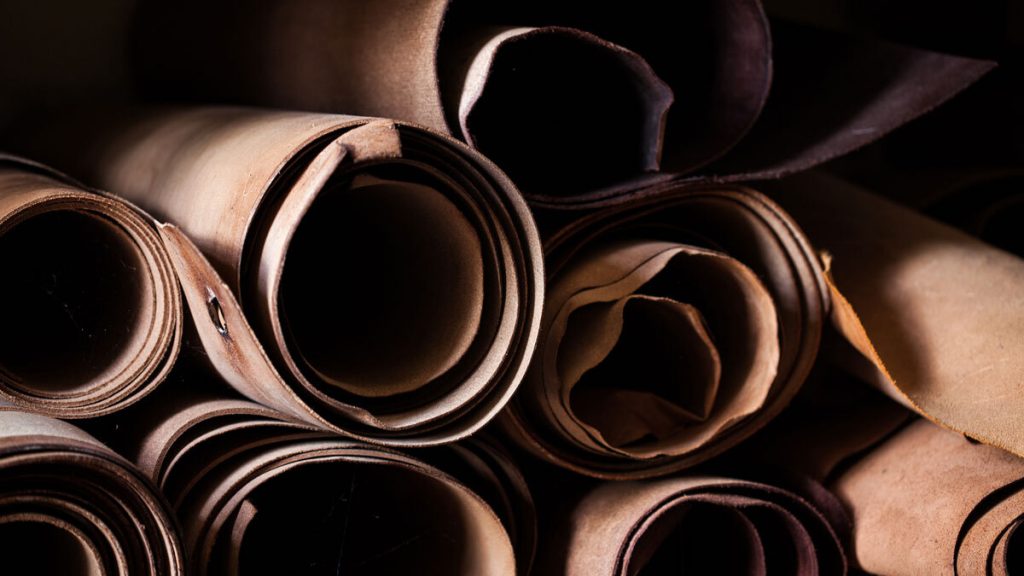
The Middle Ages and the Renaissance: a flourishing of leather craftsmanship
During the Middle Ages and the Renaissance, leather craftsmanship reached new heights. Artisans experimenting with various techniques and creating intricate designs on leather products.
Leather in the Middle Ages (4 AD – 1500 AD)
The craft continued to develop: tooling, painting, dyeing, and carving techniques were refined and expanded. Leather was used to make clothing, knife sheaths, shoes, parchment, saddles, books, and boxes. Artistic applications of leather also began to emerge during this period.
Leather in the Renaissance (1350s – 1650s)
The Renaissance saw a surge in leather craftsmanship. Artisans shaped, stamped, and moulded leather for both artistic and functional purposes. Leather was extensively used for clothing, protective gear, saddlery, and various accessories, highlighting its versatility and enduring appeal.
The Enlightenment and the Industrial Revolution: transforming the leather industry
The Enlightenment and the Industrial Revolution brought about significant changes in the leather industry. New tanning techniques and mass production methods transformed the way leather was made and used.
Leather in the Enlightenment (1650s – 1780s)
Leather continued to be used in much the same way as before, with improved fashioning and finishing techniques, to make book covers, shoes and military gear. It was also used for functional items, such as satchels, pouches, aprons, bags, belts, and hats.
Leather in the Industrial Revolution (1750s – 1900)
The Industrial Revolution had a profound impact on the leather industry. Machines enabled faster production of finished leather. The leather itself played a crucial role in the operation of these machines, with leather belts driving their mechanisms. Leather production reached its peak during the middle of the Industrial Revolution.
Patent leather and chromium tanning: new developments in leather production
Patent leather was developed in 1818. It offered a high-gloss finish that greatly enhanced the aesthetic appeal of leather products. Chromium tanning, invented in 1858, revolutionised the leather industry. It enabled faster, thinner, and softer leather production, catering to the growing demand for versatile leather products.
Modern leather: A timeless material in the 21st century
Today, leather continues to be an essential material in numerous industries. There are various tanning processes and grades available to cater to diverse needs. From vegetable and chrome tanning to aldehyde, brain, and alum tanning, leather production has come a long way since its humble beginnings.
Leather wallets, keychains, saddles, aprons, hats, and accessories are everyday items. Its versatility and durability, coupled with the skill and dedication of leather craftsmen, ensure that leather remains a timeless material deeply rooted in human history and culture.

Leave a Reply